بنية السكان في الخليج: السعودية والإمارات وقطر وعمان
Many talk about the Gulf, but few understand how differently population structures actually vary between countries. Yet that is decisive when it comes to relocation, jobs, business or long-term market opportunities. Anyone who treats “the Gulf” as one homogeneous region underestimates how far Saudi Arabia, the Emirates, Qatar and Oman diverge in demographic reality.
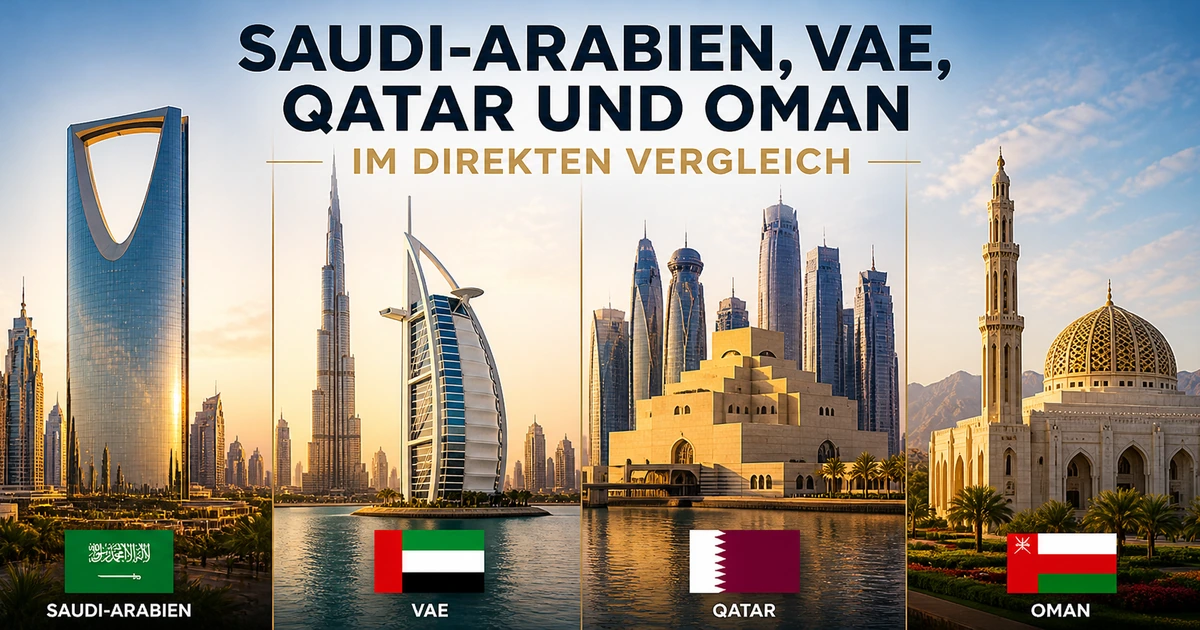
Saudi Arabia: the most balanced market of the four
Among these four countries, Saudi Arabia has the strongest local citizen base. Total population is 32.18 million, of which 18.79 million are Saudis and 13.38 million are non-Saudis. That means 58.4 % Saudis and 41.6 % expats.
What is particularly interesting is that although Saudi Arabia has a large foreign share, it is spread far more broadly than in other Gulf states. Broken down by category, the non-Saudi population is distributed as follows:
Note: 0.13 m is the arithmetic remainder of non-Saudis (13.38 m) after the four main categories—it bundles all nationalities and occupations not broken out separately.
This makes it clear: Saudi Arabia is not simply an expat labour market. It is a genuine domestic market with a strong local foundation. That is exactly why Saudi Arabia works differently from classic expat markets such as Dubai or Doha. Anyone who wants to live, invest or build a company here must understand Saudi society itself—not only foreign labour in the abstract.
United Arab Emirates: international, expat-heavy and extremely labour-market driven
The United Arab Emirates have a total population of 11.29 million. Only 1.31 million are Emiratis, while 9.98 million are expats. That makes the UAE one of the most international markets in the region.
The structure is very clear. The Indian community is by far the largest, followed by Pakistan and Bangladesh, Nepal and Sri Lanka combined; further origins at a glance:
The Emirates are therefore not a classic local domestic market but a highly internationalised economic space. That directly affects language, audiences, staffing, pricing models and business strategy. Going to the Emirates means understanding that internationalisation there is not an add-on—it is the base system.
Qatar: small, wealthy and even more shaped by the expat system
Qatar has a total population of 3.21 million, of which only 0.33 million are Qataris and 2.88 million are non-Qataris. That quickly shows: Qatar too is a heavily expat-shaped market.
The largest population group comes from the Indian subcontinent; the breakdown of non-Qataris by origin:
Qatar is thus not simply a smaller Saudi Arabia but a market with its own logic. Economically strong, structurally compact and demographically heavily driven by foreign skilled and labour migration—that directly affects the labour market, demand, consumption patterns and how you assess business opportunities.
Oman: a hybrid between a local core and significant expat presence
Oman sits demographically between Saudi Arabia and classic expat markets. Total population is 5.37 million, of which 3.05 million are Omanis and 2.32 million non-Omanis—56.9 % Omanis and 43.1 % expats.
Among foreigners, the Indian subcontinent dominates; the breakdown of non-Omanis by origin:
Oman is often misjudged. Some see only the quieter, more traditional image; others rashly compare it to the Emirates. In truth Oman is its own blend: a tangible local citizen core alongside a very relevant foreign population—that requires its own strategic lens.
What these numbers really show
When you compare these four countries directly, one point becomes very clear: the Gulf is not one uniform market.
Saudi Arabia has the strongest local base of the four. Oman also has a substantial citizen share combined with a large expat structure. The Emirates and Qatar are far more expat-driven. At the same time, all four markets show how dominant South Asian population groups have become. In the UAE, Qatar and Oman they carry a major share of total population. In Saudi Arabia they are also strongly represented but complemented by a large Saudi citizen block and broader distribution of other groups.
This is not merely a statistical observation. It directly affects market behaviour, recruitment, business models, everyday language, service structures and long-term opportunities. Anyone relocating, investing or building a company in the Gulf should treat these differences not as a footnote but as strategic groundwork.
Conclusion
Saudi Arabia, the UAE, Qatar and Oman differ not only politically or economically but already in their demographic foundations—and that structure often determines how a market really works.
In this comparison, Saudi Arabia reads as a market with a deep local foundation: a large citizen share stabilises demand, language and social reference differently than in the UAE or Qatar, where dynamism is driven more by a rotating expat system. That is not a verdict of “better or worse”—it is a different planning basis for jobs, offers and long-term investment.
Among these four, Saudi Arabia is the strongest domestic market with a local foundation. The Emirates and Qatar are significantly more expat-shaped and internationally structured. Oman sits in between and needs its own framing. Understanding these differences leads to better decisions—for relocation, employment and building a business.
Don’t want a superficial take on the Gulf?
If you want to look at Saudi Arabia or the Gulf beyond social media, headlines or relocation romance, you need more than pretty pictures. You need clarity on market, population, opportunities and real feasibility.
No theory. No hype—realistic analysis with substance.
Discuss in our community
If you have questions or want to discuss this article, you are welcome to post in our Skool community (German-speaking group for Medina & Saudi Arabia).
You need to be logged in. The community is for everyone planning to move to Medina or Saudi Arabia—we support each other, share experience and help one another.