Buying Property in Saudi Arabia – what foreigners really need to know about Medina and Makkah
Disclaimer · as of 1 July 2026
The information in this article reflects the legal and market position as of 1 July 2026. Laws, fees and procedures in Saudi Arabia may change — always check the latest official sources before buying.
Many people talk about property in Saudi Arabia as if it has all become very simple by now. Open a portal, pick an apartment, pay, done. In reality, of course, it is not quite that straightforward. Especially not when it comes to Medina or Makkah.
That is where things get interesting. And not only emotionally, because many Muslims naturally feel a special connection to these cities, but also legally. Anyone looking at property in Riyadh or Jeddah is operating in a different world from someone focusing on Medina or Makkah. The holy cities do not follow the same rules.
Since the new law, the market for foreigners is clearer in structure. But "clearer" does not automatically mean "easy". You need to understand where you are allowed to buy, what you are actually buying, and whether you personally are eligible at all. That is usually where the misunderstandings begin.
In short
What matters is not the listing or the seller's promises, but the zone, register, type of rights and buyer status – especially in Makkah and Medina.
What has changed under the new system?
Saudi Arabia has restructured property purchases for non-Saudis. In the past, much was tighter, less transparent or practically hard to grasp. Now the topic runs in a much more structured way — above all through official zones and digital processes.
The basic principle is actually easy to understand:
The state does not simply say across the board "foreigners may buy", but defines:
- in which areas a purchase is permitted,
- which type of rights is possible there,
- and for whom the whole thing applies at all.
For this there is the official Saudi Properties Portal from REGA. That is exactly where it should ultimately be checked whether a property is purchasable for the respective buyer at all.
In practical terms:
- The listing does not decide.
- The nicest brochure does not decide.
- And neither does what a seller tells you on the phone.
What matters is what is recorded in the official system for the specific property.
The first big misconception: Makkah and Medina are not a normal property market
This needs to be separated clearly from the start.
Many hear: Saudi Arabia has opened its property market to foreigners.
And then automatically think: Great, so I can simply buy in Medina or Makkah too.
That is not how it works. Stricter rules apply to Makkah and Medina than to many other cities in the country. Direct acquisition as a private individual is only intended for Muslims there. Non-Muslims are excluded from direct acquisition as private individuals.
And one more point is important:
The general logic that a foreigner legally living in Saudi Arabia can acquire a self-occupied residential property somewhere cannot simply be transferred to Makkah and Medina.
That matters because this is exactly where many start drawing the wrong conclusions.
Freehold or leasehold – what are you actually buying?
These are two terms that are constantly used. Many just nod along even though they do not know exactly what is meant.
Freehold
Freehold means, in simplified terms: true ownership. The property really belongs to you. Your right is officially registered, and you hold the asset as the owner.
Leasehold
Leasehold means: you are not buying full ownership, but a time-limited right of use – more "you have it for a long period" than "it is yours forever".
In Saudi Arabia, leasehold in practice usually means a right of use for 99 years. That is not “forever”, but for many buyers it can feel almost like ownership. You should still always verify the exact term in the contract and the register.
In the Saudi context, legal work often uses terms such as usufruct. For everyday purposes, however, you can remember it like this:
You receive a strong right of use, but not necessarily full ownership.
And now comes the point that matters for Makkah and Medina:
You should not automatically assume there that everything is freehold. In practice, you should rather expect at first that a unit may also be structured as a long-term right of use. At the same time, it would be equally wrong to classify everything across the board as leasehold only.
The truth is: it depends on the specific zone and the specific property.
So the real question is not only: "Am I allowed to buy there?"
But also: "What exactly am I buying there — true ownership or only a time-limited right of use?"
The zones – why you should not do anything without this check
REGA works with official zones. These zones decide what is possible and what is not. Which areas exist and what is generally permitted there can be seen in the official zones section of Saudi Properties — not on an agent's website and not in a listing.
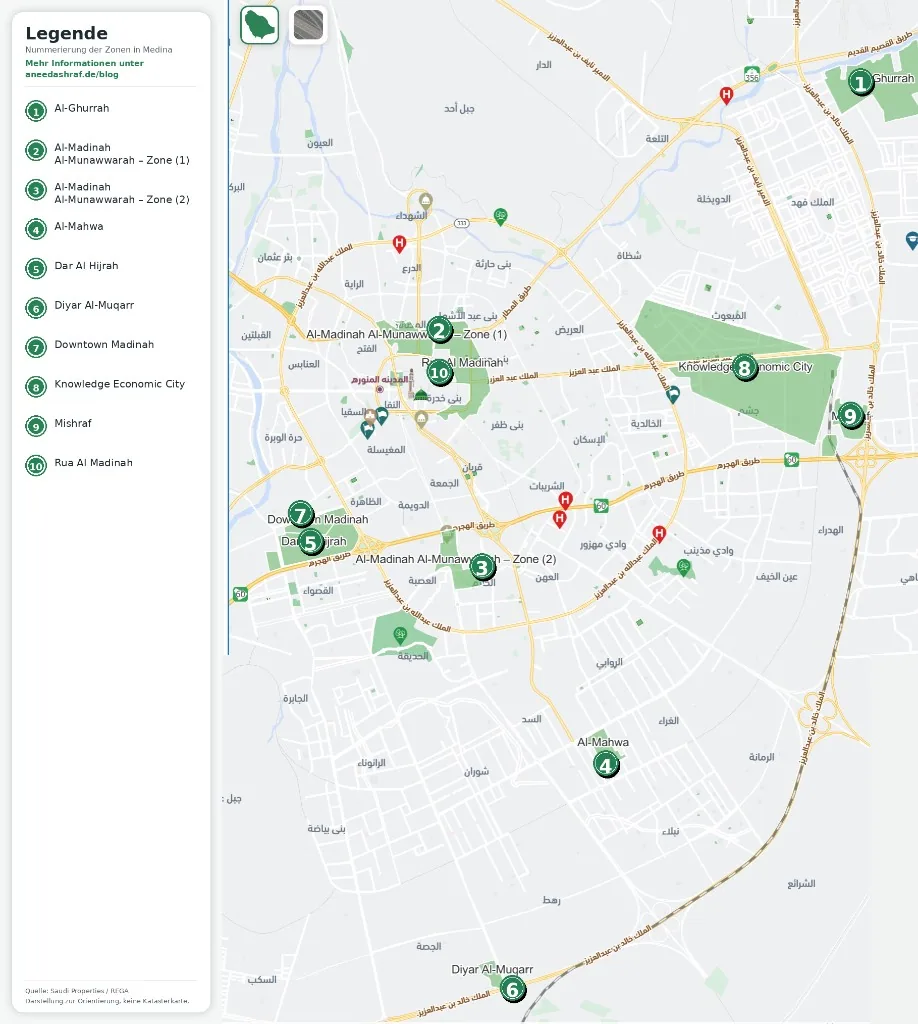
For a rough orientation, official zone names and maps such as those from Saudi Properties / REGA help. The maps below show the numbered zones in Makkah and Medina with a legend — for orientation, not a cadastral map. They do not replace an official check, but they help you understand why not every location follows the same rules.
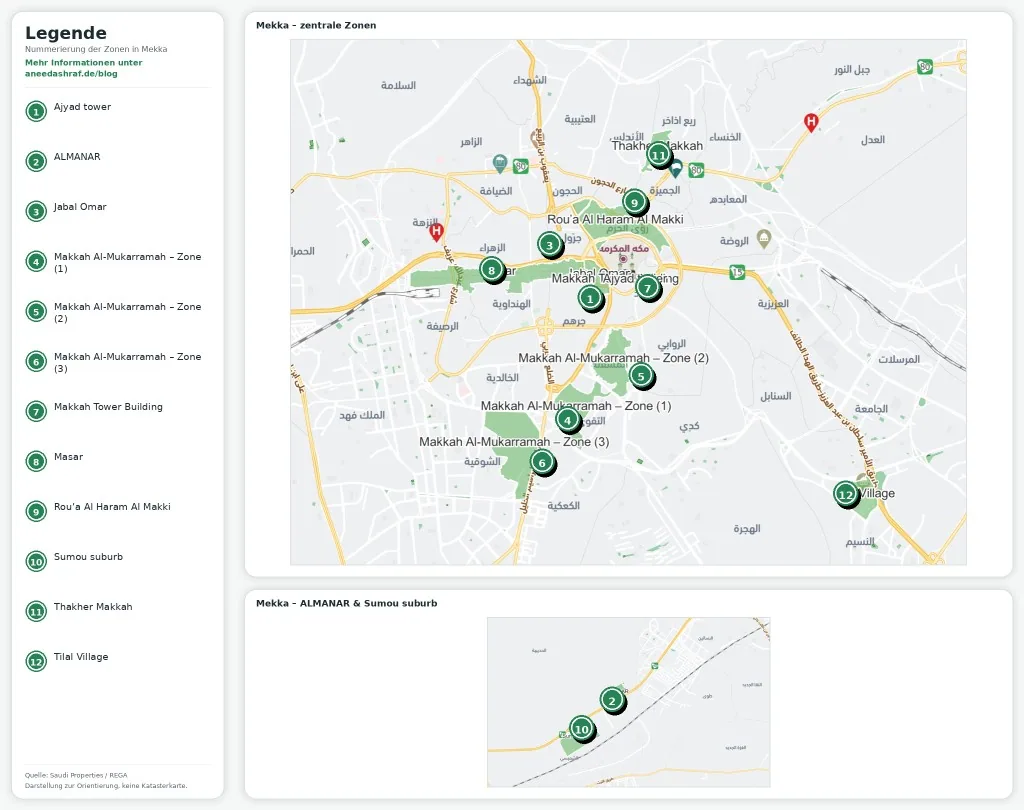
For orientation, names like these keep appearing in public:
Makkah – frequently mentioned areas
- Makkah Towers
- Al-Manar
- Ajyad Tower
- King Salman Gate
- Tilal Village
- Jabal Omar
- Thakher Makkah
- Sumou District
- Masar
- Makkah Zone 1
- Makkah Zone 2
Medina – frequently mentioned areas
- Al-Ghurrah
- Madinah Zone 1
- Madinah Zone 2
- Al-Mahwa
- Dar Al-Hijra
- Madinah Downtown
- Diyar Al-Maqar
- Rua Al Madinah
- Knowledge Economic City
- Mushraf / Mishraf
What is actually relevant in Medina in practice right now
An important practical point: even if several zones are marked on the map, that does not mean you can already actually enter finished or ongoing projects there today. Right now, buying is factually relevant mainly in Dar Al Hijrah (No. 5) and Knowledge Economic City (No. 8). Downtown Medina (No. 7) is also in development — something is already happening there, even though the market is not yet as advanced everywhere as in those two areas. In the other designated areas, either nothing has been built yet, or development has not progressed far enough for a real market entry to make sense for buyers at present.
But this also matters: even in Dar Al Hijrah and Knowledge Economic City, that does not automatically mean you can buy everywhere immediately. In these two areas too, you need to look very closely at what is actually on the market, what is still under construction, and what is still essentially development land or a building site. Much is still being implemented there, so you should not simply assume that every theoretically permitted plot is already a real and sensibly buyable product today.
This matters because many looking at the zone map automatically assume all marked areas are already actively on the market. That is not the case at the moment. The map shows permitted areas — not automatically the current construction, development or sales status. Anyone who wants to buy in Medina should therefore check not only whether an area is permitted in principle, but also whether a real project, a finished product or any sensible entry point actually exists there yet.
Whether a specific project in one of these zones is actually permitted for you as a buyer is not checked via this list, but directly in the official REGA zones portal — for the exact unit, with your buyer status.
Because the decisive point is:
These lists never replace checking the specific unit in the official system.
A project can sound good. The location can be attractive. The marketing can look perfect. And still, in the end it must be checked whether exactly this apartment or exactly this unit in this zone is permitted for exactly this buyer status.
In Makkah and Medina this is not a side detail, but the core of the matter.
Visitor ID and digital identity – why many get stuck here already
This is one of the points that many completely underestimate at the start.
If you already live in Saudi Arabia and have an Iqama, much is easier. The Iqama is the official residence permit for foreigners in the Kingdom. Anyone who has it is already properly recorded in the system.
If you do not live in Saudi Arabia, however, things look different. Then you need a different form of official identification. And that is exactly where digital identity and Visitor ID come into play.
The Visitor ID is, in simplified terms, an official visitor ID card. It matters because it can now also be relevant when it comes to bank accounts and payment processing. And that is decisive for a property purchase. Because even if you were theoretically allowed to buy, it helps little if you cannot get cleanly through identity and payment processes in practice.
How do you obtain this digital identity?
In very simplified terms, the path for non-residents runs like this:
Start via a Saudi mission
If you do not live in the country, the path usually does not begin directly in the property portal, but rather via a Saudi embassy or mission abroad.
Recording your identity
There the foundation is laid so that you can be officially recorded digitally in the Saudi system.
Factor in the Visitor ID
In parallel, the Visitor ID becomes important because it represents your visitor identity in the Saudi system and can also play a role in banking in practice.
Only then does the purchase make technical sense
Many make the mistake of already talking about contract, price or reservation first, even though their identity side is not properly prepared yet. That often costs time later.
Put simply:
Before you can seriously buy, you first need to be digitally ready to buy.
The actual purchase process – step by step
If you break it all down, the purchase usually runs roughly like this:
That sounds simple on paper. In practice, a lot depends on how thoroughly the groundwork was done.
The register – why it matters so much today
In the past, many thought mainly about contracts and deeds when buying property. Today the official property register is much more important.
The register essentially shows:
- who owns the property,
- which rights apply to it,
- whether encumbrances exist,
- and whether everything is properly documented.
For you as a buyer that means:
A property with a clean register status is much more trustworthy than a property where only nice documents are presented but the actual registration is unclear.
In a market like Saudi Arabia you should not be casual about that.
Taxes and fees – what you really need to budget for when buying
When buying property in Saudi Arabia, many look only at the purchase price at first. That is understandable, but not enough. The most important standard cost beside that is the real estate transaction tax, i.e. RETT. According to ZATCA, this is generally 5% of the value of the property. The authority describes it as a general tax on the sale or transfer of ownership of a property – not as a special rule for residents only. What matters first and foremost is the transaction itself, not whether the buyer lives in the country or not.
Real estate transaction tax (RETT)
5% of the property value — according to ZATCA the most important standard block beside the purchase price
In practical terms:
If you buy a property as a foreigner, you generally need to keep this 5% in mind. That applies especially when you are not a resident and are preparing the purchase from abroad. RETT is therefore not a minor extra cost, but one of the most important standard blocks beside the actual purchase price.
Important, however: that does not mean residents and non-residents are otherwise treated completely the same. In the actual purchase process there are of course differences – for example with Iqama, Visitor ID, digital identity, bank account and the question of whether you are permitted for the specific property at all. RETT should be viewed separately from that. It is the general tax on the property transaction itself.
It is also important that, besides the general 5% real estate transaction tax, a recent media report on the implementing regulations of the new law suggests an additional 2% fee on property transactions by foreigners in certain cities. The same report mentions that false or misleading information can lead to fines of up to 5% of the value of the respective property right, capped at a maximum of 10 million SAR.
For buyers this means in practice: when buying property in Saudi Arabia you should not only look at purchase price and location, but also take additional fees, identity requirements and proper legal completion seriously.
In addition to RETT, further costs may arise in individual cases, for example for:
- register procedures
- powers of attorney
- translations and certifications
- agents
- bank processing
- ongoing service charges in the project
- ongoing operating costs
That is exactly why when buying you should not only ask: "What does the apartment cost?", but always also: "What does the whole transaction really cost me in the end?"
Especially with larger projects in Makkah and Medina you should not calculate as if it were only "apartment price plus done". In many cases there are further ongoing costs attached.
What do foreigners typically buy there?
In Makkah and Medina, foreign buyers usually focus more on:
- apartments
- serviced apartments
- units in larger development projects
- pilgrimage-related or hospitality-related property
Classic detached family homes, as you might expect in other markets, are less typical.
That also fits the structure of the holy cities: there the focus is more on dense development, large projects and sometimes very location-specific models.
Purchase via a company – often the stronger structure, but not without risk
Buying property via a company is generally possible in Saudi Arabia and for many investors is even a much stronger route than a pure private purchase. The system is not designed only for individuals, but also for companies. Especially when a property is not only to be held privately but rented out, used operationally, further developed or deployed as part of a larger wealth-building strategy, the company structure is often the cleaner and more professional solution.
The big advantage is obvious: the property then runs not in your private name, but directly through the company. That can make much more sense fiscally, operationally and strategically, especially if further properties, investors, rental models or business activities are added later. Anyone thinking seriously about property in Saudi Arabia therefore often thinks structurally first, not privately.
The flip side
If the property is bought via the company, it legally belongs to the company and not to you privately. That also means it is fully tied to that entity. As long as the company is set up cleanly, that can be a real advantage. If the company later runs into difficulties, becomes insolvent or comes under legal pressure, however, the property is part of that problem too. Anyone buying via a company therefore often gains more structure and more options, but also carries the full business risk.
Especially for Makkah and Medina, the company structure is particularly interesting for many because private purchase there is much more restricted. Still, here too: a company is not a free pass. In the end, the specific zone, the specific type of rights and the specific property always decide.
In addition, it is publicly confirmed that for the holy cities there is also the indirect investment route via listed Saudi companies with a property connection. In the relevant cases, a 49% limit applies there for non-Saudi participation. That shows exactly how important the right structure is in Makkah and Medina.
Can you also invest indirectly?
Yes, and for some that is even more sensible — especially when a direct private purchase in Makkah or Medina is not an option anyway.
Not everyone has to or wants to buy an apartment directly. There are also indirect routes, for example via:
- listed Saudi companies with a property connection
- funds
- investment structures with a property connection
That is of course something different from a direct private or company purchase. Especially in the holy cities, the participation limit for non-Saudis often plays a role. For investors who want to deploy capital rather than use the property themselves, however, this route can be quite interesting.
Where the biggest risks lie
Honestly, the biggest risk is usually not the price.
The biggest risk is believing a property is purchasable and suitable even though exactly this structure does not work cleanly for exactly this buyer.
The most common problems arise here:
- the zone was not checked properly
- freehold and leasehold were confused
- the identity side was not prepared
- the register was not checked seriously enough
- the seller was trusted more than the official system
- property ownership is confused with the right of residence
Buying a property in Makkah or Medina does not automatically give you residency, no special visa and no special Hajj or Umrah rights either. That is very often mixed up. It should be kept strictly separate.
What you should really check before buying
In practical terms I would always tick off these points beforehand:
- ✓ Is the property really in a permitted zone?
- ✓ Which type of rights do I get exactly?
- ✓ Am I personally permitted as a buyer at all?
- ✓ Is the property cleanly registered?
- ✓ Is the agent or seller properly licensed?
- ✓ Is my identity and banking structure prepared?
- ✓ Do I really understand what I am buying there?
If you are unsure about any of these points, that is not a small problem. Then you are not yet at the point where you should sign.
For whom are Makkah and Medina really interesting as purchase locations?
For Muslims with a genuine connection to the holy cities, a purchase there can be emotionally and strategically very compelling. But this is not a market for people who simply look romantically at a listing.
It is especially interesting for people who:
- really want to understand the rules,
- calculate not only emotionally but also soberly,
- proceed in a structured way,
- and are willing to engage with zones, register, identity and types of rights.
Anyone who simply wants "an apartment in Medina" without understanding the logic behind it will quickly notice that it is more complicated than they thought.
Conclusion
Buying property in Saudi Arabia is clearer today than it used to be. But Makkah and Medina remain a special case. There it is not enough to see only a nice project and be inspired by the location.
You need to understand:
- where the property is located,
- what you legally receive there,
- who is allowed to buy at all,
- how you become technically and practically ready to buy.
If that is properly prepared, Makkah and Medina can be very interesting. If not, a supposedly beautiful opportunity quickly becomes an unnecessarily complicated case.
In the end it is simple:
Not the nicest marketing decides, but zone, register, type of rights and buyer status.
Key terms explained simply
Further reading
- • Investing in Medina
- • Saudi Premium Residency — including the property owner model
- • 4 legal ways to Medina
- • Saudi cities compared
Discuss in our community
If you have questions or want to discuss this article, you are welcome to post in our Skool community.
You need to be logged in. The community is for everyone planning to move to Medina or Saudi Arabia in general – we support each other there, share experiences and help one another.
Ready for the next step?
Let's analyze your situation and find the best path for you. Discreet, direct, and based on real experience.
Book an expert call