Online Homeschooling & Structured Online School: Why It Can Work So Well for Muslim Families and Expats
Many Muslim families no longer think of school as only the classic on-site model. Especially when emigration, Hijrah, frequent moves, or a more conscious Islamic way of life matter, another question becomes central: How can a child learn in a stable way even when the family does not stay in one place?
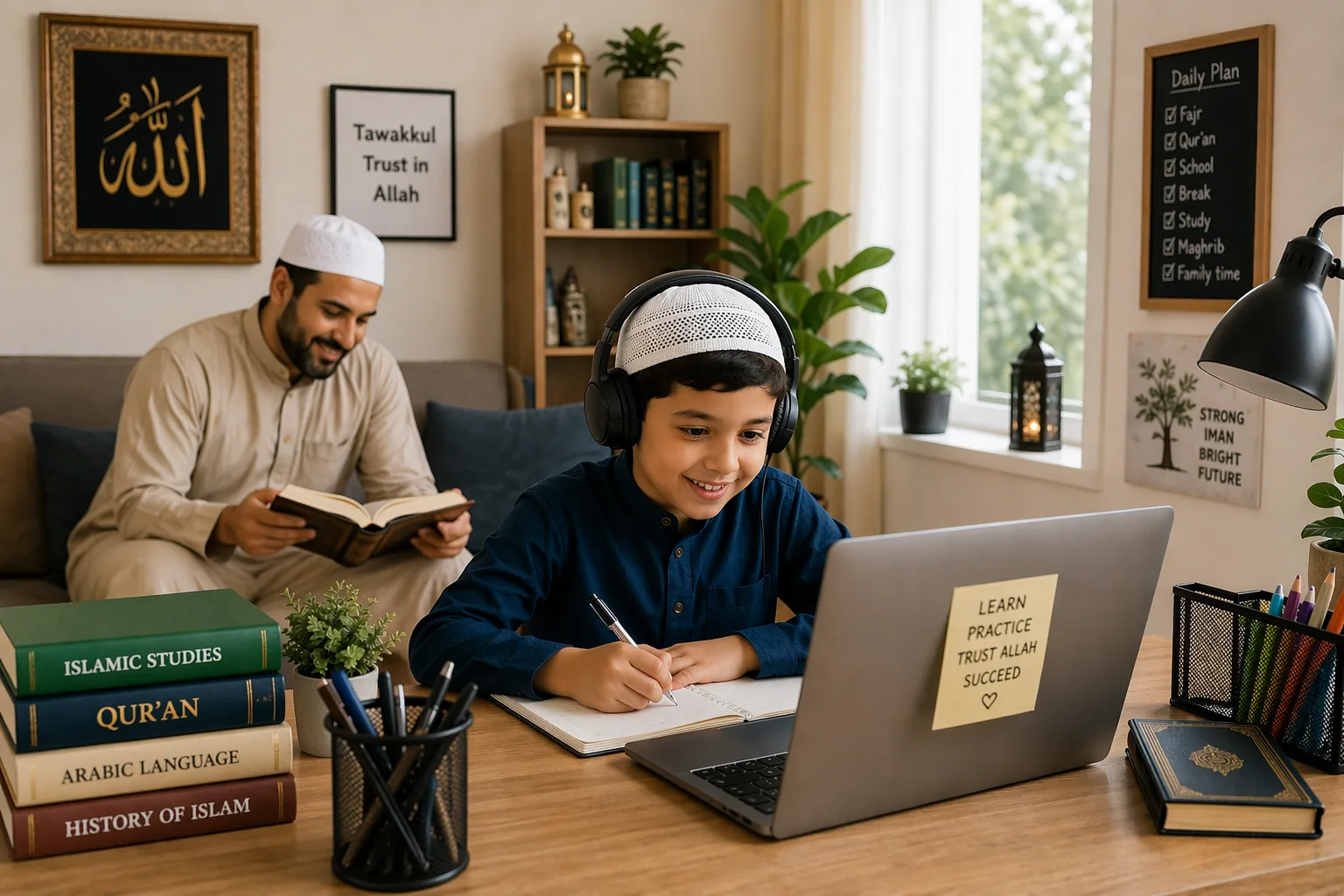
This is where homeschooling in the sense of a structured online school becomes highly relevant for many families. This does not mean that parents have to teach every subject themselves. It means a model where the child takes part in a fixed online school from home or any other place—with a timetable, curriculum, teachers, assignments, and clear learning goals.
For Muslim families and expats, this model can have huge advantages—but only if you really understand it. Even when an online school offers flexibility, that does not mean school can run on the side. That would be a mistake.
In short: what we mean by “homeschooling / online school” here
Not meant: that mother or father teaches every subject alone. Meant: the child follows a fixed, external online school—with real lessons, real teachers, real learning goals. Only the place differs, not the seriousness of schooling.
Much depends on this later: without clear, conscious parenting and structure at home, neither a laptop nor the most polished course is enough.
A school that moves with the family
One of the biggest advantages of an online school is that it is not tied to one place. If a family emigrates, switches countries, or lives somewhere else for a while, the child is not completely torn out of a school system each time. For many families, that is one of the heaviest strains of a move: new school, new language, new rules, new authorities, new exams.
With a good online school, the child’s education can stay stable—whether the family is in Germany, Saudi Arabia, Turkey, Malaysia, or anywhere else. The timetable stays. The curriculum stays. The line of learning stays. For many children, that is a major stability factor, especially when much else is changing.
That gives not only the child but the whole family security.
What a good model often keeps even when the home changes
- the same school identity and pathway (curriculum, qualification logic),
- fixed dates, commitment, and familiar processes,
- for many: the same peer and study group online,
- less “starting from scratch” on every move.
Often a much better fit for Muslim families
For many Muslim families, school is not only about education but also about values, environment, and safety. A well-chosen online school can often match this far better than the default local model.
Parents can steer much more deliberately what environment the child learns in, which influences act on them every day, and what the day looks like overall. The child is not automatically handed to a context that is religiously neutral or even at odds with the family’s values. Instead, the family can build a system that better fits their life.
In religious terms, that is often much more valuable—not because every online school is “Islamic,” but because the day can be structured differently. Qur’an time, Arabic, Hifdh, Islamic study, or a clear rhythm around Salah, family, and learning fit in far more easily when the family is not fully locked to a rigid local system.
Many families see the biggest shift here: the child does not just “do school,” but the family finally gains real room for focused Islamic education.
When learning is no longer “school in one corner of my day” but fits a rhythm the whole family lives, Islamic parenting rarely feels like “double duty”—it feels like one life. You still have to fill that in yourselves, but the model can create the space.
Flexibility is a blessing—only if the family takes school seriously
Typical trap: flexibility is confused with anything goes. The model fails there—not because of the platform.
We need to be clear: just because an online school is more flexible, it must not be taken more lightly.
Some families make the biggest mistake here. Once lessons are at home, the illusion quickly appears that school can somehow run in the background—that you can start later, interrupt, reschedule, and “relax” more. In reality, the model only works if the family takes it at least as seriously as any other school.
The child must understand: even if lessons are not in a school building, it is still real school. There is material, responsibility, deadlines, performance, and growth. Being at home does not make it less binding.
Muslim families who want more freedom must be careful that freedom does not turn into sloppiness.
More transparency helps—only if parents really engage
A point that is often underestimated is how much more transparent online schooling can be. In many brick-and-mortar schools, parents only partly see what really happens in class. They see results, homework, or report cards, but the learning process itself often only in fragments.
Often in on-site schools
Learning happens “behind the door”—parents see the outcome (grades) more than the process (notes, focus, misunderstandings).
Common in online models
More insight into flow, materials, and feedback. Useful—but it does nothing if you ignore the information.
In many online schools it is different. Parents often have much better access to materials, tasks, learning status, and how lessons are run. There are not infrequently regular 1:1 meetings with teachers, where you can target what the child needs. Depending on the school, lessons may be recorded. That is a real advantage if a child needs to review—when they were ill, missed something, or did not understand the first time.
But you must be equally clear: this transparency only really helps if parents lean in too.
Putting the child in front of a laptop in the morning, leaning back, and hoping it all runs by itself usually fails in an online model. “Sleeping and waiting” is not a model. An online school is only strong for a child when parents are behind it—thinking along, accompanying, and really caring about the process.
This is a major difference from the classic school. In a normal system, a child can sometimes “ride along” with limited parental insight. Not ideal, but the system carries a lot. Online, that is harder. Quality here depends more on whether parents are present, ask questions, keep structure, take feedback seriously, and work with the day-to-day.
That does not mean parents have to become teachers. But they must help hold the frame. They must look. They must notice when the child switches off, does not understand, slips in organisation, or stops following inside. So higher transparency is a huge win—if the family is willing to use it actively.
A calm environment is not a bonus—it is a requirement
Homeschooling can only be strong if the child can actually learn at home. That takes more than a laptop and internet.
A child needs a quiet, clear, low-distraction place to learn. Not a TV on all day. Not constant in-and-out. Not a day where school is theoretically important but in practice lost between sofa, kitchen, talk, and distraction. That is why official home education guidance in England (GOV.UK) stress that parents remain responsible for a suitable full-time education.
If home is to work as a school, the child needs a real frame: a fixed place, clear times, predictable breaks, and a sense that learning has priority right now. Some children need only a good desk and quiet. Others need more structure, supervision, and guidance.
So homeschooling is not “school without a building”—it is school inside family life. And that family life must actively carry the learning.
Small classes and teachers with real time
A major benefit of good online homeschooling is the learning context itself. While many children in brick-and-mortar schools sit in large classes of 20, 25, or more, many online schools deliberately work with much smaller groups—often about 6 to 12 children. That does not slightly improve teaching; it can change it fundamentally.
| Model (typical) | Common group size (approx.) |
|---|---|
| Classic full-time on-site school | 20–30+ students per class |
| Many online programmes (core subjects live) | ~6–12 in a learning group |
Numbers vary—what matters is the ratio of learning to attention, not the label “online.”
In small groups, a child is less likely to get lost in the mass. Teachers see more quickly where a child is strong, where help is needed, and where they may be switching off. They can ask, explain more individually, and take more time per child. The child is not just co-taught but actually seen.
And let’s be plain: big classes, constant noise, social unrest, endless distraction, and group pressure are not an ideal learning setting for many children. Some handle it better than others—but calmer, more focused, more personal learning is a plus for almost every child, especially sensitive, introverted, or easily overstimulated children.
For many families, that is one of the strongest reasons for an online school: the child learns in a frame that is not built on chaos but on structure, calm, and real attention.
Children often start to like school again
A point many parents only feel in daily life: some children begin to see school more positively in a good online model. Not because everything is easy, but because learning becomes more individual and more human.
When teachers have time and really know a child’s name, strengths, weaknesses, and quirks, it changes the relationship to learning. School is no longer only a system that grades performance, but a space where the child is accompanied.
Peers in many online schools are often a different type too. They are in a similar model, with similar flow and challenges, and often a comparable home context. That does not remove every conflict, but it changes the tone. The classic school day—volume, social dominance, group force, “the strong one wins”—often becomes much weaker in that form.
Issues like bullying, constant ranking fights, or mental load from a restless class climate can shrink. No school is conflict-free—but for many children the day becomes calmer, safer, and less driven by unnecessary social pressure. That is when some families first see a child not fighting school but starting to like it again.
Less exam stress than the classic German model (but still serious)
A difference many parents feel immediately is in exams. Many online systems—especially international ones—do not work like the classic German model, where class tests, grade phases, and promotion hang over every week.
That does not mean there are no tests. Online schools assess too—tasks, tests, quizzes, essays, and other work. In many programmes, these checks serve learning first: they show where the child stands, what is understood, and what needs more work. They are often more of a pedagogical tool than a constant pressure tool.
Compared with the German school day, many families find that a big relief. The child does not live in permanent fear that every single test instantly decides stress, promotion, or self-worth. The baseline tension drops.
Checking learning does not have to feel like existential pressure all the time. In many international programmes, tests are more tools for learning—but without real study beforehand, no pattern helps, however gentle it looks.
Example: English system—less daily grind, but more long-term planning
In the UK, pathways are often clearly laid out. The curriculum in England works with Key Stages, and the upper years often lead to GCSEs and, depending on track, to A Levels. Cambridge IGCSE is very common internationally for ages 14–16; Cambridge AS & A Levels are typically 16–19 and used in many countries. (See e.g. GOV.UK: National curriculum and exam board materials.)
For families, that can be a real advantage: structured, academically legible, internationally recognisable. At the same time, be honest: a stronger focus on the qualification phase also means more self-responsibility, more planning, more long-term structure. You cannot push everything forward and hope it sorts itself out.
So it is not “easier”—it is built differently. Less daily exam panic can be a big win—but that only works if the family takes the system seriously and plans ahead.
Curricula that matter for Muslim families and expats
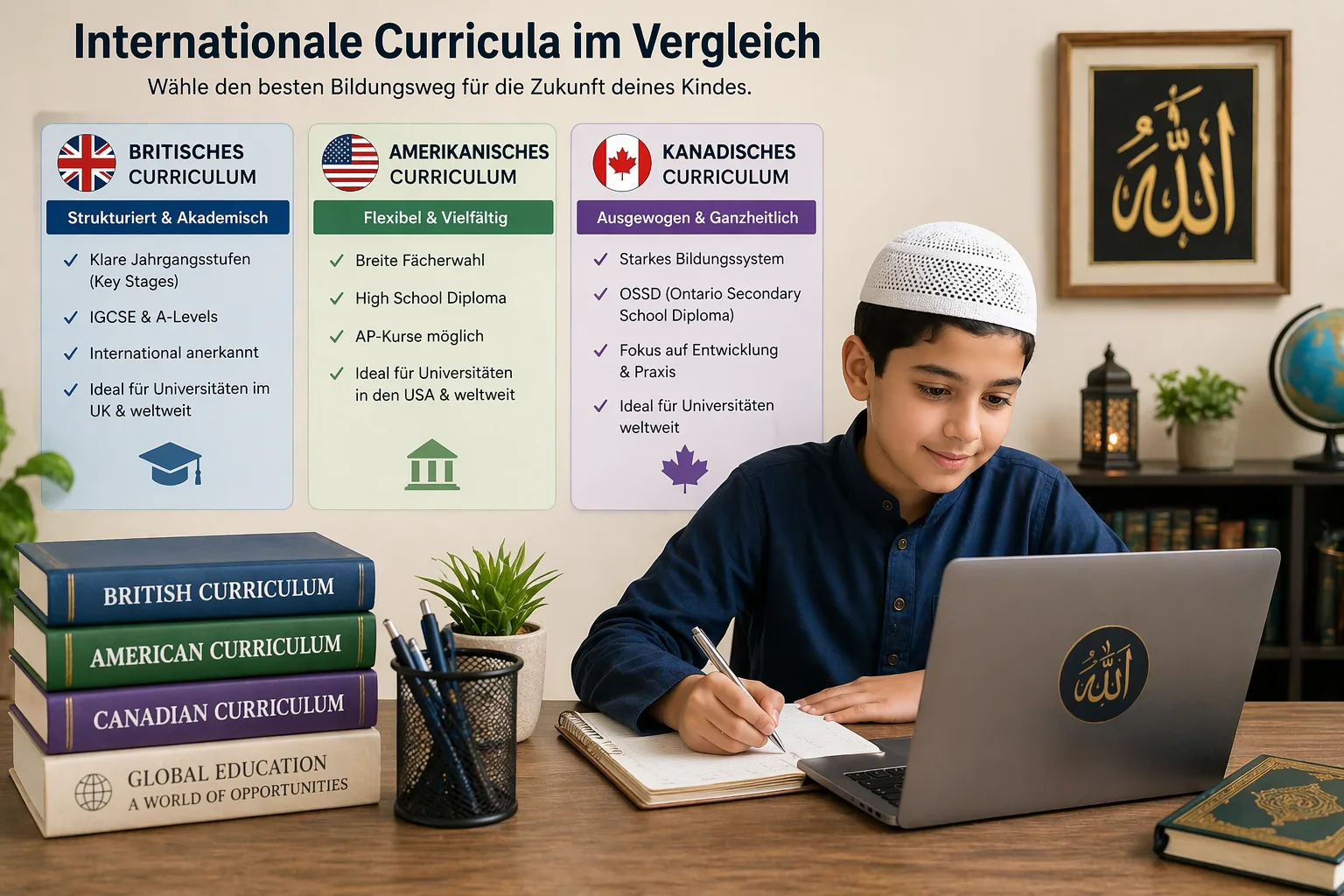
When families look for a good online school, in practice they often end up on two main tracks: British and US curricula. Serious options also include Canadian (e.g. Ontario OSSD), Australian, New Zealand, or IB-style routes. These are not limited to a single country. (See e.g. Ontario—online learning (secondary) for context; always verify details with the provider you choose.)
The British curriculum
The British model is attractive to many expat families because it is very clearly structured, with well-known stages, and is easy to explain internationally. Many choose it for structure, academic strength, and global recognition.
Many British-style online schools have clear exam pathways, which gives parents security. The system can also be more exam-heavy—which suits some children well and feels heavier for others.
If a family wants clarity, discipline, international recognition, and a more classical academic track, the British path is often a strong option—Key Stages, GCSEs, and onward routes like AS & A Levels are a big part of why mobile families like it. (Entry point e.g. GOV.UK.)
The US curriculum
The US model is often more flexible and broader. There is no single national UK-style curriculum; high-school requirements vary a lot by state and district. Schools can add depth via AP courses. The AP programme (College Board) offers many subjects, ends in standardised exams, and can help with entry, credit, or placement at many universities.
For families who want more course choice or dislike a very rigid model, the US system can be attractive. Quality varies much more by provider. “US curriculum” alone is not a complete label.
If you want more flexibility, electives, and a broad school profile, this can fit well.
UK-style path
Strong thread, clear Key Stages, usually a visible line to GCSE / IGCSE and beyond. Good when clarity and global recognition matter.
US-style path
Often wider course choice and differentiation. Good for a more varied profile—but check provider quality; “American” is not a fixed guarantee.
Curriculum language: do not underestimate it
If a family opts for an English-medium curriculum, this needs a very honest look: the child must be able to really work in the language of instruction. Children often pick up languages quickly, especially with regular exposure. In daily life, though, it is a big gap between “some” English and processing lessons, tasks, explanations, and subject vocabulary in English, week after week.
Remember
Casual English and academic, exam-ready work in the same language are not the same cognitive load.
It often makes sense to plan extra, targeted English support—especially at the start. That can be private tuition, an extra tutor, or a dedicated language programme. If a child could keep up on content but is always behind on language, the whole set-up gets unnecessarily hard. The issue is not necessarily the child or the school—it is often a language foundation that is not yet strong enough.
English as medium
- Build in targeted support early
- Tuition, extra tutor, or language training as needed
Staying in German (on purpose)
- Often wiser if returning to Germany is realistic
- If you want learning in German to stay a clear goal
This does not mean every expat family must go English-medium. You can stay in the German system on purpose—and for many families that is the more sensible path, especially when a later return to Germany remains open or you want the child to keep learning in German.
Deutsche im Ausland e. V. (DIA) – how it helps
The overview from Deutsche im Ausland e. V. (DIA) shows that German families abroad can follow several routes—including German schools abroad, international schools, and digital or school-parallel options. It also makes clear that German schools abroad often offer the strongest fit with the German school system if “re-joining” in Germany is a real scenario.
There are also German online schools aimed at families who live location-independently but still want a clear German educational pathway.
For Muslim families and expats, the takeaway is: you do not have to default to an English programme just because you live abroad. A conscious international path can work if the language is really there. If you want stability in the German system, there are now ways to keep learning in German and still be mobile.
Private tutors as a plus—and a big extra load
Another big advantage: families can add support flexibly. If a child needs extra help in a subject, you are not limited to what a local school happens to offer. You can work with private tutors—online or in person.
For families who want to push individually, that is a strong lever. A tutor can close gaps, deepen hard topics, or accelerate in specific areas: maths, English, Arabic, sciences, Qur’an, or Islamic studies. The online school holds the main structure; the tutor meets the child where they individually need it.
But you have to be clear: the extra effort is real—not a little, often a lot.
As soon as parents add private tutors, organisation jumps: coordinating times, aligning content, checking goals, and keeping the child moving cleanly between school, tutor, homework, and life. That takes more time, more overview, and often more mental energy as a family.
It can be very worthwhile—if you are honest about what it means. A tutor is not magic. It only helps if the family can carry the extra work. For some it is a huge win; for others it is too much, fast.
Extracurriculars are not optional—they are part of the plan
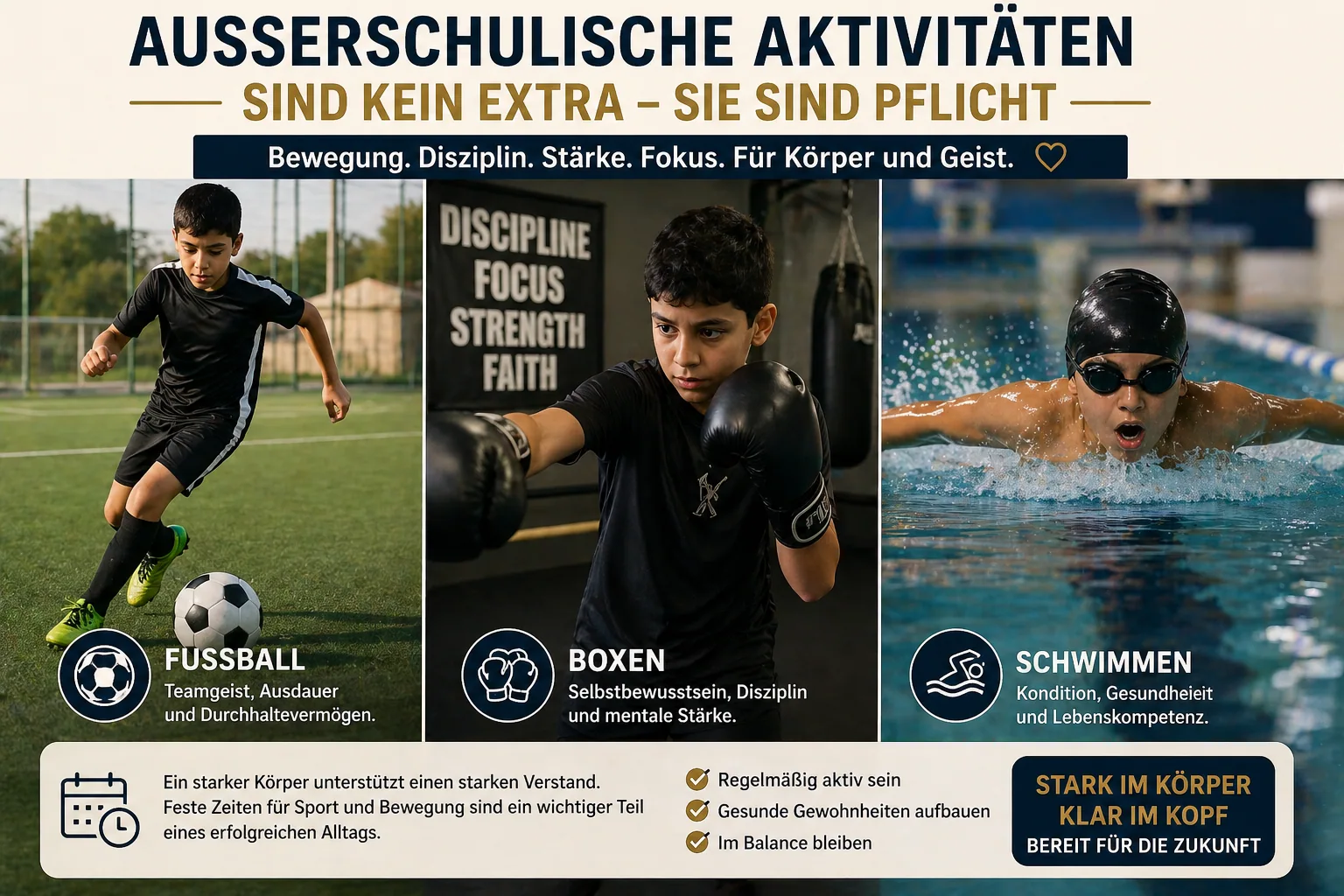
However strong an online school is, it is not the whole of a child’s life. Extracurriculars must be planned on purpose in this model.
A child who learns mostly on screens needs physical activity—not now and then, but regularly and seriously. Sport, martial arts, swimming, horse riding, club activities, or other fixed physical slots should be part of the plan, not a “nice if we get round to it.”
Many online classes include short movement breaks—stand up, stretch, quick exercise. That is good. It is not a substitute for real sport or long-term physical development in daily life.
So families must correct on purpose. If school is at home, the day must not slide into screen, sitting, and indoors only. Activity is not minor here—it matters for health, focus, discipline, and emotional balance.
Real-world contact is as important as school stability
Another point families must take seriously is the child’s social world. An online school can be academically strong—but it must not mean the child lives only in digital relationships.
Not enough
Classmates only as a voice in a headset, group chat, forum. That can build teamwork—but it does not replace being together, arguing, and making up in person.
Add on purpose
Fixed off-screen places where peers, adults, and values show up—sport, masjid & community, neighbourhood, volunteer groups.
So: build real social space on purpose, do not leave it to chance. Many cities have homeschooling communities or family networks with a similar life—often organised through messengers, meetups in parks, sports halls, or hired rooms.
Examples of where real nearness can grow (varies by country)
- a regular sport or martial arts club, swimming, riding—weekly, not “someday”;
- small, reliable play or study meetups with one or two other families;
- local homeschool groups: families in the same model—regular meetings, play and learning, trips; often via messenger and social, varies by city;
- where available: co-ops / study groups (one subject, one afternoon a week—still real contact).
What matters is less many contacts than recurring ones where the child can show up, practise conflict, empathy, endurance, and fun without a mute button.
It is also not rare for children in the same city to attend the same online school. Shared school, subject, or city can turn into real study groups and friendships. For many families, that is a big win: school stability and social life can be woven together.
Remember: online is the medium for learning. Being human—showing up, waiting, helping, laughing—happens in the room, the club, the yard, wherever you honestly invest time.
So never read online school as “only tech.” It works best when family, learning, movement, and deliberate, real nearness to peers are planned together—not hoped to “sort itself out.”
The model does not need to sound modern—it must fit
The biggest mistake would be liking an online school only because it sounds modern, flexible, or international.
The real question is always: does this model fit our child and our family life?
Some children bloom in an online school—calmer, clearer, more stable. Others need more in-person contact, social exchange, and outside guidance.
Both can be right.
The decision should not be ideological or purely emotional. Not every traditional school is bad, and not every online school is automatically better. What matters is whether the model really helps the child—academically, emotionally, socially, and spiritually.
Families for whom this model is especially strong
Online school in a homeschooling set-up is especially strong for Muslim families who want to emigrate, already live abroad, move between countries often, or want more influence on their children’s learning context.
It is strong for families who want stable school structure while the home base stays mobile. It is strong for those who want Islamic education woven more deliberately into the day. And it is strong for children who learn better in a calmer place than in big traditional classes.
It is often a poor fit for families with no day structure, for parents who like school in theory but rarely accompany in practice, or for children who lose focus quickly without clear outside guidance.
Conclusion
At a glance
Strong when family, rhythm, and a real place to learn line up. Risky when “online” is wishful flexibility and parents stay at a distance.
Homeschooling through a structured online school can be an outstanding model for Muslim families and expats. It combines education with flexibility, offers stability across moves, and room for a more conscious Islamic day-to-day. The fact that the school can move with the child—wherever the family is—is a big part of the value.
At the same time, it only works if the family takes it seriously. Online school is not “less school” because it is at home. The child needs structure, calm, accompaniment, social off-screen space, and a real learning frame. If private tutors are added, that can be a huge strength—but only if the family can really carry the extra time and organisation.
If you build this model well, you can give a child not only school continuity, but also something more families need today: an education that actually fits the life you live.
Discuss in our community
If you have questions or want to discuss this blog post, you are welcome to post in our Skool community (German-speaking group for Medina & Saudi Arabia).
You need to be logged in. The community is for everyone planning to move to Medina or Saudi Arabia—we support each other, share experience, and help one another.
Ready for the next step?
Let's analyze your situation and find the best path for you. Discreet, direct, and based on real experience.
Book an expert call