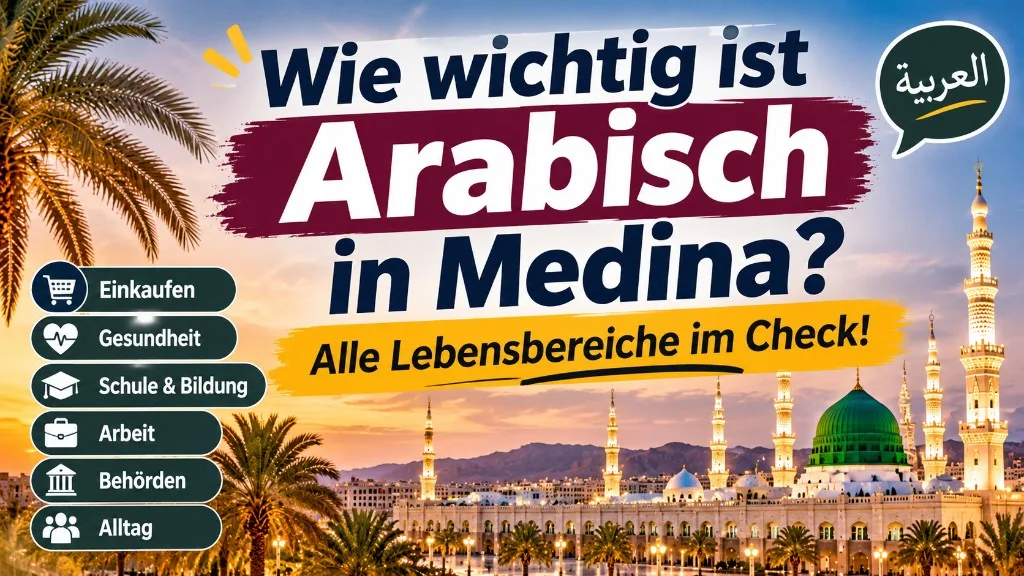
How important is Arabic in Medina, really? Every part of daily life, checked
Plenty of people ask whether you can manage in Medina without Arabic. Few get an honest answer. Shopping, the doctor and school work well in English. At work, in the mosque and at a government counter, Arabic decides speed and access.
In short
Across every part of life we give Arabic 6.7 out of 10. In Medina it is not a luxury for enthusiasts, and it is not a ticket without which nothing works. It is the difference between guest and neighbour.
Medina is not an expat city
The 2022 census counts 1,411,599 people in the city of Medina, 585,507 of them foreign nationals, about 41 percent. Many come from Pakistan, India, Bangladesh and Indonesia and do not speak Arabic as a first language. Medina still has not organised itself around English the way Dubai has. How Saudis and foreigners are spread across the Gulf is in the comparison of population structures.
Arabic is the country's only official language. On 3 February 2026 the Council of Ministers approved the National Policy for the Arabic Language. The aim is a stronger place for Arabic in daily life, government, schools and business. The framework sits with the King Salman Global Academy for Arabic Language.
How to read the scores
Each area gets two numbers. The Arabic score from 1 to 10 shows how much the language matters once you are in the situation. Contact frequency shows how often that happens. 1 means almost never, 10 means every day.
Arabic score
- 1–3 · nice, not required
- 4–6 · saves time and stress
- 7–8 · without Arabic you regularly need help
- 9–10 · decides the outcome or whether you get in
Contact frequency
A high score on a once-in-a-lifetime appointment weighs differently from a medium score on every working day. The top right of the matrix is where Arabic pays off most: often and urgent. The top left is urgent but rare, so a translator is enough. The bottom right is daily life you can handle in English.
Every area at a glance
The overall 6.7 is the average of the nine areas. For government offices the in-person score is the one that counts. Online, the same area is only 2 out of 10.
Often, and it decides
Work and the mosque
This is where every hour of study pays off. You need Arabic regularly, and English will not carry you.
Rare, but hard
Offices, contracts, neighbours
Not a daily event. When it happens, language decides. For appointments, one person who can speak for you is enough.
Every day, in English
Shopping and school
High contact, low pressure. An international school and the supermarket can be organised in English.
Helpful, not required
Doctor and housing
The right clinic, plus a broker or a friend, gets you there. Arabic makes it faster and more personal.
Government offices, iqama and residency
The main government apps, including Absher and Tawakkalna, run in Arabic and English. Iqama renewal, exit/re-entry and family data can be done online without the language.
In person, the picture flips. With some luck someone helps you in English. Most staff speak Arabic. Without a translator, a counter appointment becomes very hard. Typical errands in the first months: issuing the iqama, registering family members, attesting documents, transferring a driving licence. A mistake here often means coming back more than once.
Marriage and birth certificates for family visas usually need a certified Arabic translation. A translation office does that, not you. Allow a few days. After the first stretch you rarely go back. The big exception is a car accident or an appointment with the police.
Practical tip: Take someone who speaks Arabic to government appointments. That applies to the first months and to emergencies such as an accident.
Contracts, law and courts
Employment, lease and company contracts in Saudi Arabia are normally available in English as well, so you can read what you sign. Legally, the Arabic text is the one that counts: for documents with legal effect, Saudi law treats the Arabic version as binding. Court hearings are in Arabic.
The real question is how often you touch this. Rarely. Three typical moments: the employment contract at the start, the lease on Ejar, and, if you incorporate, the articles of association. After that the file usually sits in a drawer for years. Arabic becomes decisive the moment there is a dispute. Then you need a lawyer or a translator.
Practical tip: For a company formation or an investment, compare the Arabic and English versions briefly. For an ordinary employment or lease contract that check is usually low-risk.
Work and career
Work in Medina is different from Riyadh or Jeddah. In the workplace people speak almost only Arabic, with colleagues, managers and customers.
As a business owner
Staff, suppliers, government offices, banks and partners. Starting without a trusted person who speaks Arabic quickly makes you dependent on third parties. How a formation is supported is on the services page.
As an employee
Meetings, WhatsApp groups, a quick word in the corridor. People who can join the conversation are included faster and given responsibility sooner.
Saudization adds another layer. Many roles are filled with Saudis first. As a foreigner you stand out where you bring something others do not. Arabic plus English is one of those combinations.
Health and hospitals
Many doctors in Saudi Arabia trained abroad or are foreign nationals themselves. Depending on the hospital, almost everyone speaks English, from reception to nursing. What matters is which clinic you choose.
Private facilities employ many international doctors and nurses, and English is part of the working day. In a small clinic or a pharmacy, English can run out. Health insurance usually comes with a network of approved hospitals. Look at that list early.
Practical tip: Before the first emergency, pick a clinic where English is standard and save the address and phone number. If you want to work in healthcare yourself, hospitals and application routes are in Working in healthcare in Medina.
Housing and landlords
Many landlords in Medina are Saudi. Viewings and price talks often happen by phone or WhatsApp in Arabic. English, a broker, or a friend who translates for a minute will still get you there. Leases are registered on the government platform Ejar. Extra agreements and repairs are settled directly with the landlord or the building caretaker.
Contact is intense mainly while you are searching. Listings are often bilingual or Arabic only. A translation app is usually enough for the advert and a first message. After you move in, contact shrinks to rent, small repairs and the annual renewal.
Many caretakers and tradespeople are from South Asia. English or a little Urdu often gets you further with them than formal Arabic. What housing and daily life cost is in What living in Medina really costs. Anyone who wants to buy instead of rent needs the rules for foreigners in Makkah and Medina.
Shopping, errands and transport
In the supermarket, at the bakery or in a phone shop, the person behind the counter in Medina is very often from South Asia. English, Urdu and Hindi take you as far as Arabic. What actually reaches the table, region by region, is in Saudi cuisine. Around the Prophet's Mosque, traders have adapted to pilgrims. Many speak Urdu, Hindi or Malay alongside Arabic and English.
Taxis are ordered in an app, prices are on the till, signs are usually bilingual. Delivery apps, ride apps and banking apps can normally be switched to English. Arabic here is comfort, not a requirement.
Practical tip: Learn the numbers, a few polite phrases and the most useful directions. That covers most everyday life in Medina.
Mosque, religion and Quran
Visitors get a lot of support at the Prophet's Mosque. Living in Medina means wanting more than orientation. The Friday sermon, study circles, questions to scholars, Quran recitation: all of that is in Arabic. Translations exist. They stay a summary.
There are more ways to learn Arabic now than there used to be. Anyone who wants to actually follow the scholars in the Prophet's Mosque cannot go around the language. A translation app gives you the core, not the depth.
Understanding the recitation in prayer changes the time in the Prophet's Mosque. For many Muslims that is the main reason to learn Arabic, and the area where every hour of study returns the most.
School and children
In public schools, Arabic is the language of instruction. It is not the only route. International schools teach in English. Homeschooling through an online school is another model many relocating families use. Arabic is still usually a subject at international schools. For children that is a bonus.
International schools charge fees and give a fixed timetable on site. Online schools are more flexible and travel well if you move again later. As a parent, Arabic shows up mainly at enrolment, school events and with other parents. At international schools that usually works in English too.
Practical tip: Decide before the move whether your child will go to an international school or an online school. More in homeschooling through an online school.
Neighbours, friendships and fitting in
Many expats in Medina live in a mixed circle of colleagues, other foreigners and their own community. English, Urdu or a mother tongue is enough there. Winning Saudi neighbours, families and friends takes Arabic.
Medina is conservative, family-centred and very hospitable. Invitations, weddings, conversations after the prayer: that happens in Arabic. Saudis in Medina often stay among themselves. Entering that circle runs through the language. Contact rarely appears on its own. The mosque, sport or colleagues are the realistic doors.
Simple sentences already change how you are received. Greeting neighbours in Arabic, asking how they are and accepting invitations reads differently from staying in English only.
Getting by works. Settling in needs Arabic
Medina forgives missing Arabic at the shops, at the doctor and at school. It does not forgive it at work, in the mosque or at a government counter. Anyone planning to live here for the long term should treat Arabic as part of the move, alongside visa, housing and budget. The legal routes into the city are in four legal ways to Medina. Anyone who wants to stay without an employer should also look at Premium Residency.
A clear target level
Matched to your profile: daily life, work, the mosque, or all three.
Start before the move
The first months are full of appointments. Starting only afterwards is the harder road.
A translator for the hard appointments
Government office, police, a dispute. A trusted person beats hoping the counter speaks English.
Patience with the dialect
Formal Arabic opens the door. Daily life adds the Hijazi tone.
Urdu and Hindi take you a long way
Almost the entire labour force in Medina speaks Urdu or Hindi. In the supermarket, the restaurant, the taxi, on a building site, with the caretaker or in a workshop, many workers from Pakistan, India and Bangladesh speak Urdu or Hindi with each other.
If you speak one of those languages, daily life opens up a long way, often further than English. For contact with Saudis, at government offices and in the mosque, Arabic remains the key.
Sources, November 2026
Population of the city of Medina: 2022 census, 1,411,599 people, of whom 585,507 are not Saudi nationals. National Policy for the Arabic Language: Council of Ministers decision of 3 February 2026, published in Umm Al-Qura, text at the King Salman Global Academy for Arabic Language. The score for each area is our own reading from practice in Medina.
Discuss in our community
If you have questions or want to talk about this article, post it in our Skool community.
You need to be signed in. The community is for anyone planning a move to Medina or to Saudi Arabia more broadly. People there support each other, swap experience and help one another along.
Ready for the next step?
Let's analyze your situation and find the best path for you. Discreet, direct, and based on real experience.
Book an expert call